Abstract
From research about the church community beahaviour and member flow to most cruel design of a bench. How religion evolved to fit modern needs.
Introduction
We live in a time when trust in traditional institutions is decreasing. This includes politics, media, governments, and religion. And yet, people continue to join groups that give them community, purpose, and a feeling of belonging. I have always been interested in why people join religious groups and what role these communities play in modern society. Growing up in Poland, where Christianity is strongly present in culture and everyday life, I wanted to understand how religion functions in a different environment such as the Netherlands.
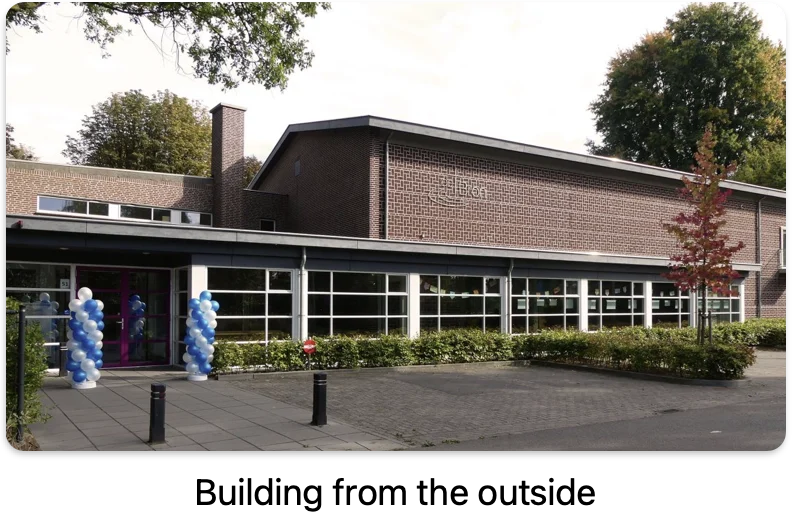
One practical challenge of this research was finding people willing to talk. Many communities are difficult to approach from the outside, especially when discussing personal beliefs. My fieldsite was chosen partly because of accessibility. During fieldwork in Eindhoven, I met volunteers from De Bron who were actively talking with people in public spaces and inviting them to join their community. Since they were already open to conversation, they became a natural starting point for my research.
My goal was to understand who joins religious communities, why they join, what they believe, and how they see the purpose of life. I was also interested in comparing their views with my own experience of Christianity in Poland.
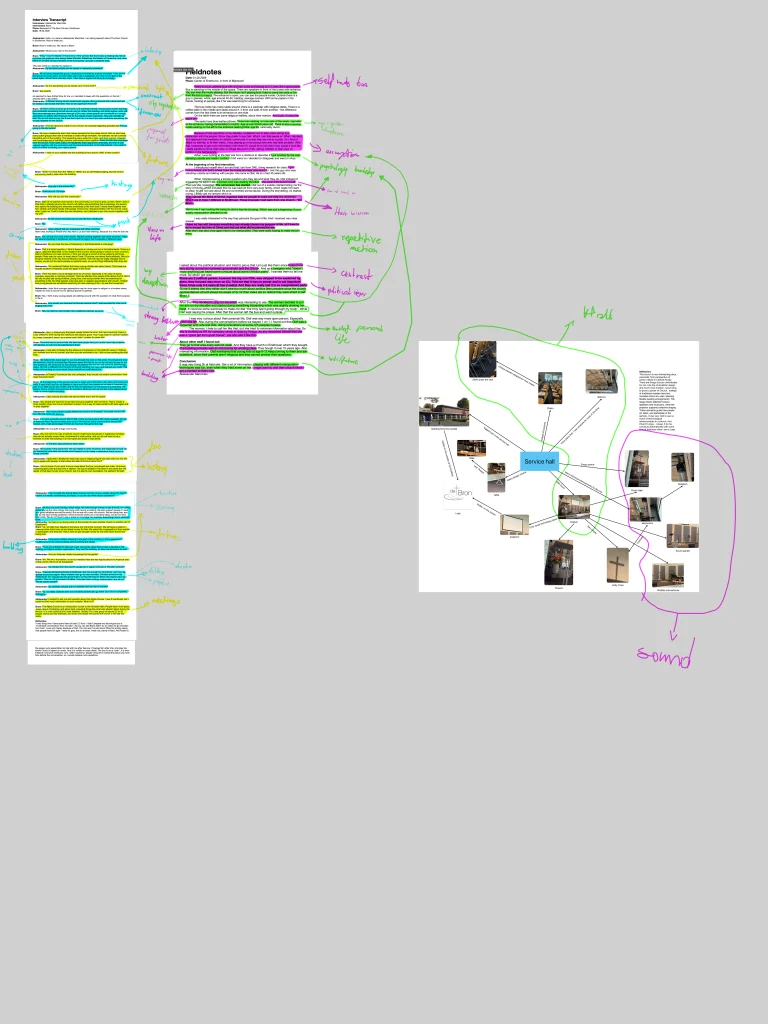
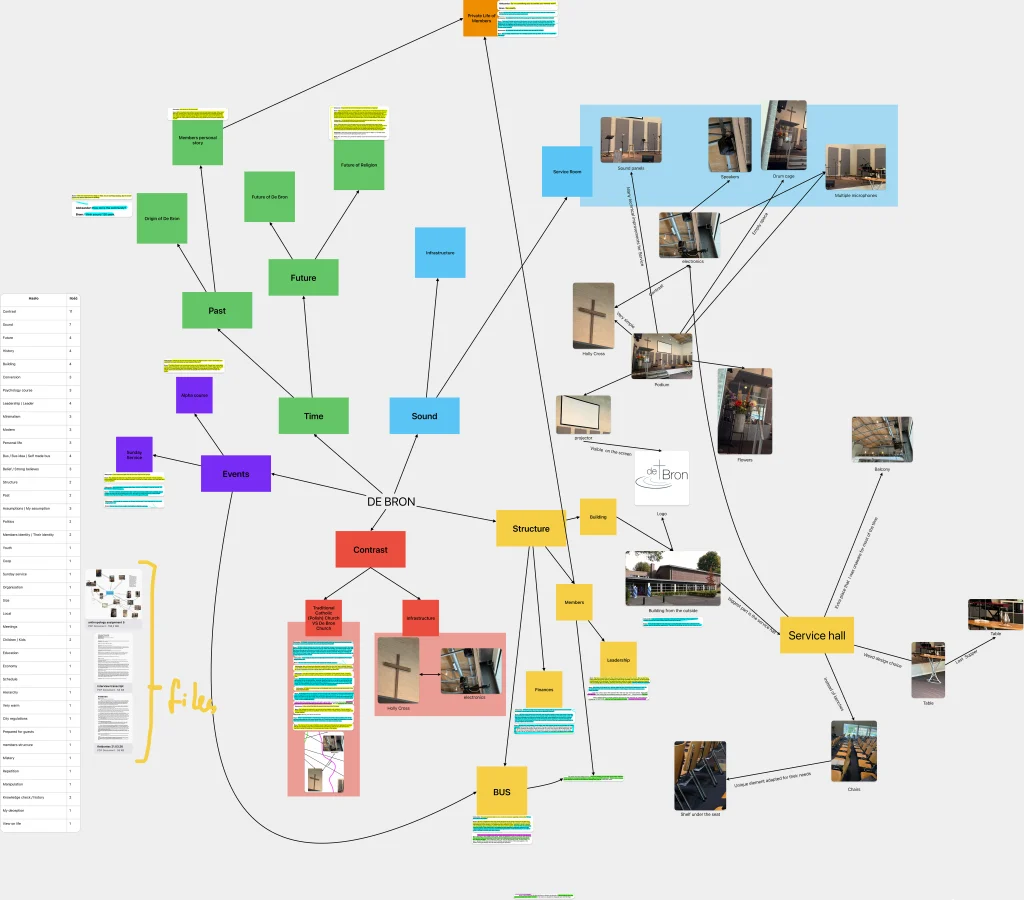
To answer these questions, I attended a Sunday service, conducted interviews, made observations, took photographs, and documented the church environment. This allowed me to study both the people and the space they use.
Methodology
De Bron Church Community
De Bron is a small protestant church, located in Eindhoven it stands out, by the fact they manage an “excursions” every second weekend to the city centre, to spread the Word of Christ. Since I knew my social skills are far from perfect, I was looking for a community, that wants to talk, and wants to be heard. I was greeted very warmly by them. Spend a lot of time on debating with their members on topics that are not just practical, but also philosophical, like point of life. I wanted to understand them. To be them.
Eyes of a person raised in traditional catholic society
Of course my eyes were looking a bit critically for the whole time, since I come from different society with different traditions. My origin allowed me to compare, what changed? how? why?
I wanted to use this contrast, for my research.
Methods of data collection
I have collected data among weeks, mostly by straightforward conversations, meeting with members and participating in their routine. However I was worried about if they would like to talk to me for no reason. I decided to build my identity to be a “carrot on a stick”. Basically by saying I am from catholic country with deep religious roots in the family (not a lie), who is young and lost in new environment (not fully a lie either). I stated that, I am not believing anymore, because I am struggling, this way I got more chance to actually listen to them more.
Another reason is that my private life will be used as a force to expose my weak spots, I started my journey with expectations it is a sect and I did not want to be part of it since my personal view on religion are critical. I met similar people before and knew, they will ask about my private situation which is not the best. So I had to set up a “not fully fake” life background. I think it is understandable.
Analysis
Size
From my visit in the building of De Bron Church I gathered most important information for my design choices. Starting with the size. I noticed there are 2 rows with 9 chairs each. According to “Neufert” a reference book for a building design and site planning. The wideness of a seat should be 40cm, depth and height 45cm.
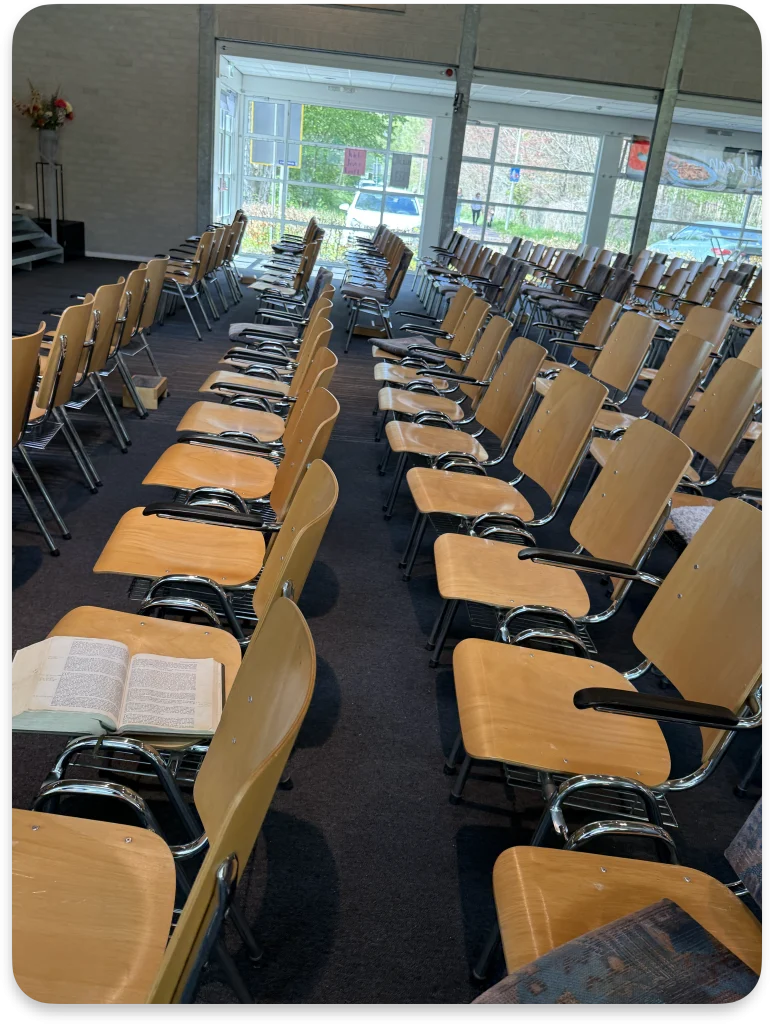

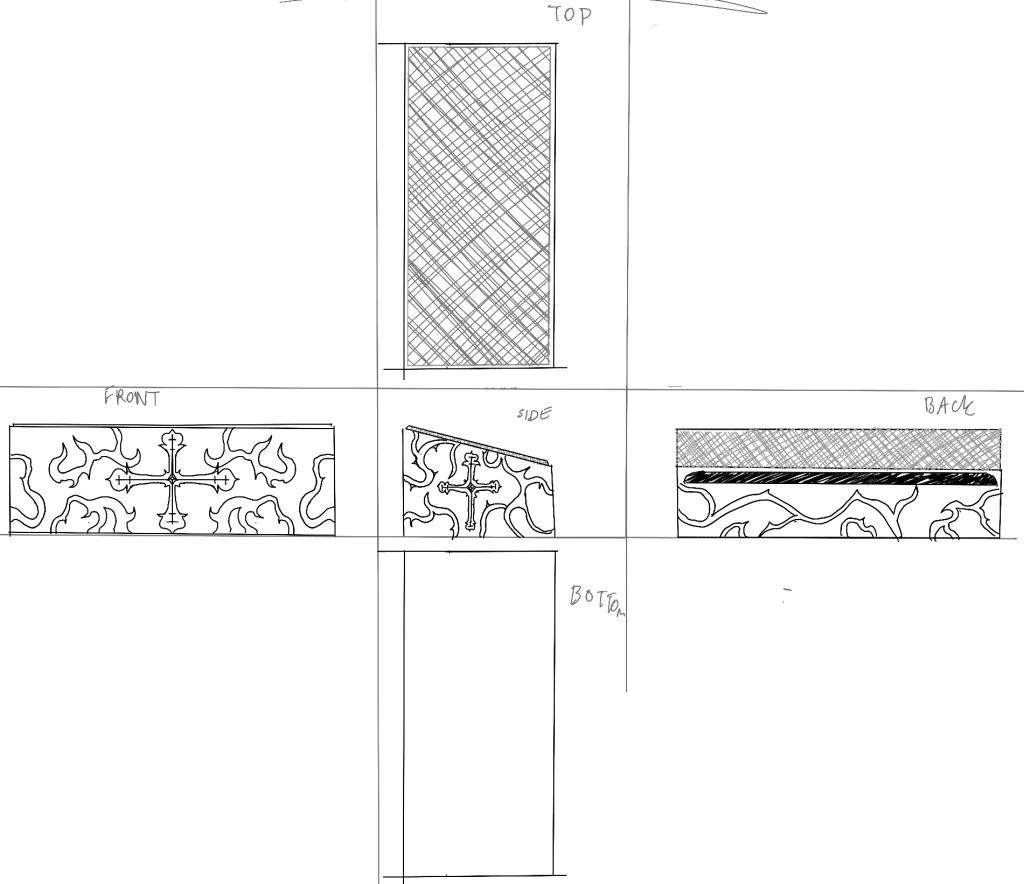
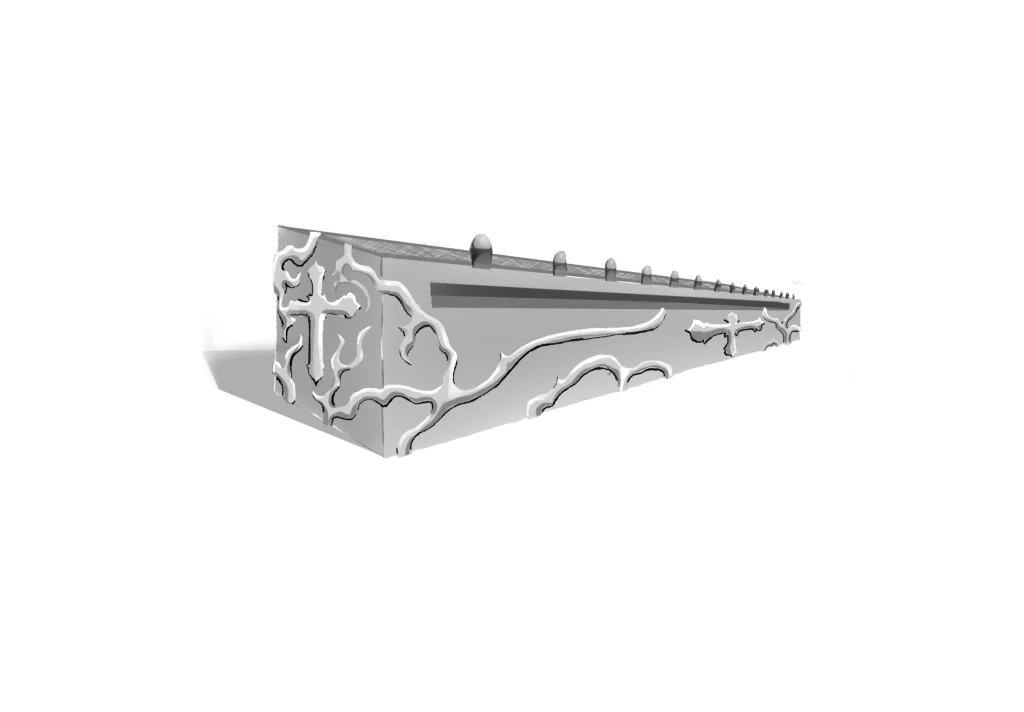
Characteristic element about all the churches are the rows of seats, and when you are late, you need to excuse everybody on your way. The longer the row, the more people you need to ask. That is a useful fact, since I am doing an anti-design. To sum up, 9 chair, 2 rows, each 40cm wide, this gives us 9x2x40cm=720cm=7.2m . This is going to be step by step building of a bench. And like in any 3D design app, you start with a cube. My cube has dimensions 45x720x45.
Shape
From the photo we can get details about this chair. It has a skeleton build, profile wooden seat under your knees, backrest and of course small angle towards the back. This is an important piece of data. Backrest is strictly connected to the angle. And skeleton keeps the chair lightweight, which as mentioned during the interview, was an imporant factor, that caused need for switching from the bench to chairs.
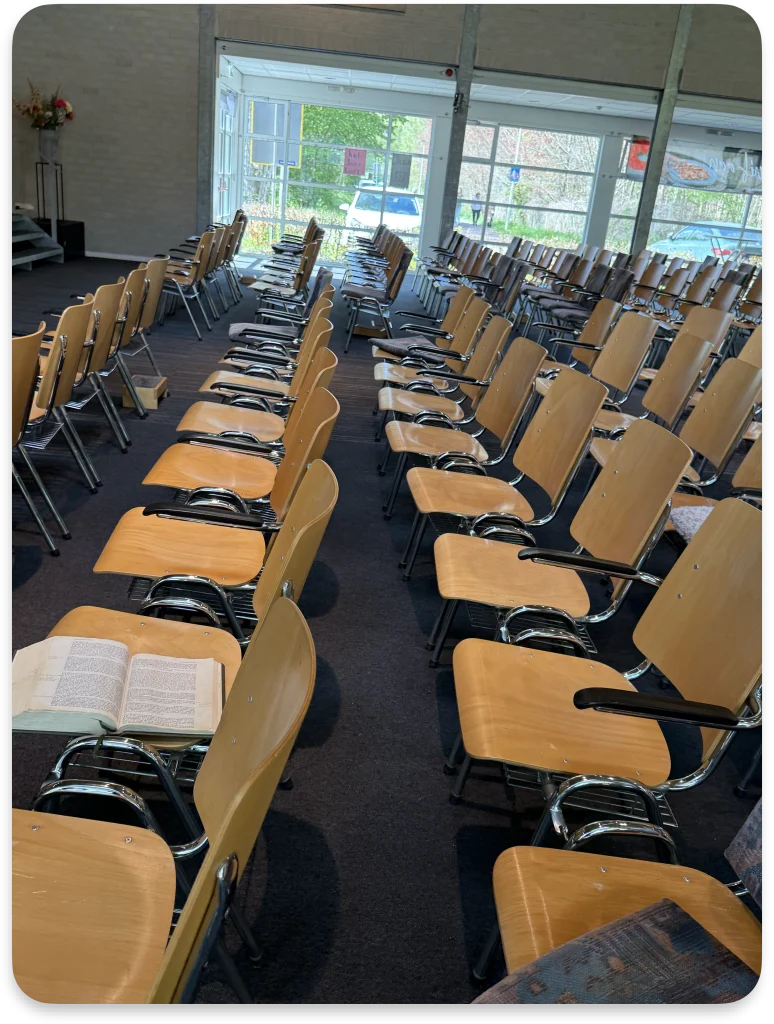

If we get rid of the backrest, and keep the angle, we receive a very uncomfortable seat, if we make the knee corner sharp, it gets worse. On top of that, we can increase the angle, from 5deg, to 10 degrees. Continuing this we should do something with the skeleton build, which we can basically make it the opposite, which would be a pure block, maybe of concrete? We’ll se later.
Underseat shelf
Unique part of theses chairs is the shelf. Under the seat. That gives a lot of possibilities, the question is how to make it uncomfortable? Because just removing the shelf is boring easy.
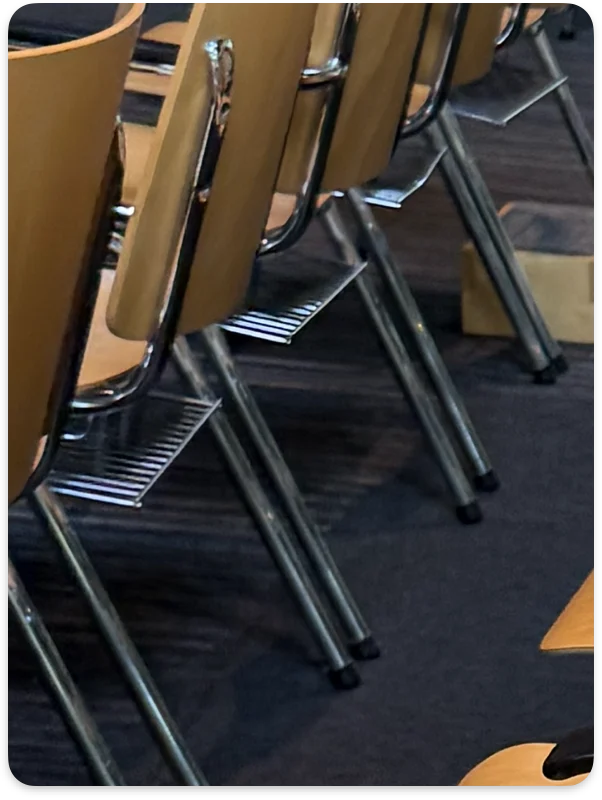

The anwer is, make it one and long. right under the seat. And this gives the idea about a material of the seat itself, which should be a textile, that bends under pressure, so when you want to put your bible, you simply tickle their ass… yeah I had to write that…
Ornaments
The whole church lacks any kind of ornaments, it is purely practical design, which is a complete opposite to traditional catholic church.

So the answer is I should add some nice ornaments, to make it look beautiful, like vine.
The Seat
More detailed, about the seat, the chairs have hard wooden surface, profiled around knees, to increase comfort.
Like mentioned before, soft material, a textile, would do here. So this is the choice I am going to make. Also the wood is natural, so if the textile is the opposite, let’s make it true opposite. Synthetic textile, I thought of the one used in sunbath chairs, called polyester mesh.
Sound Experience
The element of the church (and the community itself) that stands out is, the focus on sound experience and use of music. They focus a lot about it by putting sound pannels on the walls, in a church. A sound cage for the drums to keep the sound clean, also a lot if speakers, sound technician, live translation system.
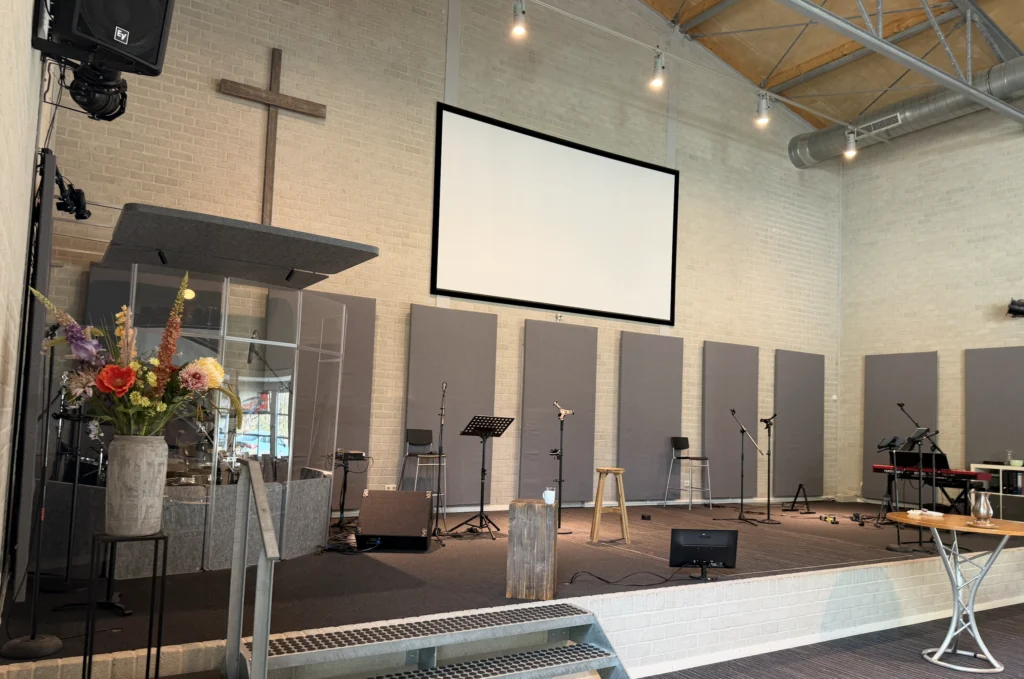

My desing choice is going to be brutal. If the sound experience is important, let’s make it very important. There is a technology of sound transmission called bone conduction. It is used in earphones nowadays. But, it would be to simple to make give them an earphones connected to the bench. My vision is beyond that, it is a tailbone conduction. All you need to do is have a physical contact, with a transmiter (no it’s not gonna be a dildo, even tho it could work). It can work with just a small piece of metal touching your tailbone or backbone, however the sound is not gonna be the highest quality, it is gonna actually transmit it. To transmit the sound you need a transformer, that changes the input audio, into vibrations. Which will take a lot of space and will require a lot of cooling. So we get a free AC to keep everyone warm during winter, and warmer during summer. It can be located inside of the block, to hide it.
Material choice
In the chairs they used metal and wood. From the design route I choose, I need a heavy piece of something.
First thought that comes to my mind is concrete block. Concrete is a wonderful material, whenever I think of it, it reminds me of communism, an idea that was in theory supposed to protect the society from the bad elite. Kind of like church in theory, who helps the poor.
Also I already made a choice of polyester mesh for the seat itself.
I still think of something that could work as material for, the ornaments. Metal is a strong and heavy material, also cold in touch. Which is opposing to what I found in De Bron.
Discussion
Of course nothing went easy and without any problems. Mostly it was my time schedule, that was not matching the open hours of the church. It opens every second day. Which is a complete opposite to what I know.
I personally believe that if not, the problems with time, I could gather even more information about things I did not explore, which is the financial status. It is my personal obsession, since the high-positioned priests in Poland are driving brand new Maybach, or other luxury cars.
Also it was not the first fieldsite, there was an idea of use of elevator, but it completely went wrong, so I choose this instead. I personally struggle with social contact in NL, (mostly because of my temperament and cultural difference) so it was easier for me to communicate with someone who wants to talk.
Conclusion
To sum up the design I made is a pure evil, for De Bron. I would like to show them the final work, but they need to understand it is a joke and sarcastic point of view. Not any kind of disrespect.
It was very interesting to see with eyes of ex-catholic, how the religion evolved. In some aspects positively, in some negatively.
Reference
- Neufert E. (2011). Architects’ data (4th English ed.)
- Aleksander Marciński (2026)
Process Archive